


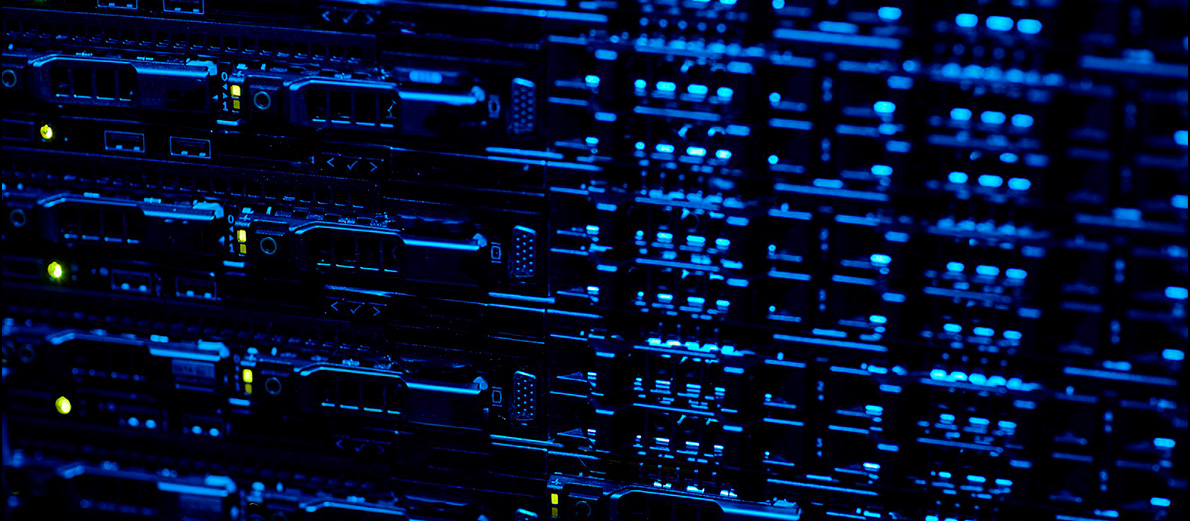
Traditional servers are too large, noisy, and power-hungry. As infrastructure grows, these problems only intensify. It’s at these times that companies begin to consider blade servers—a compact and efficient IT infrastructure solution. We explain what blade servers are and how they differ from conventional hardware.
Briefly: What is a blade server?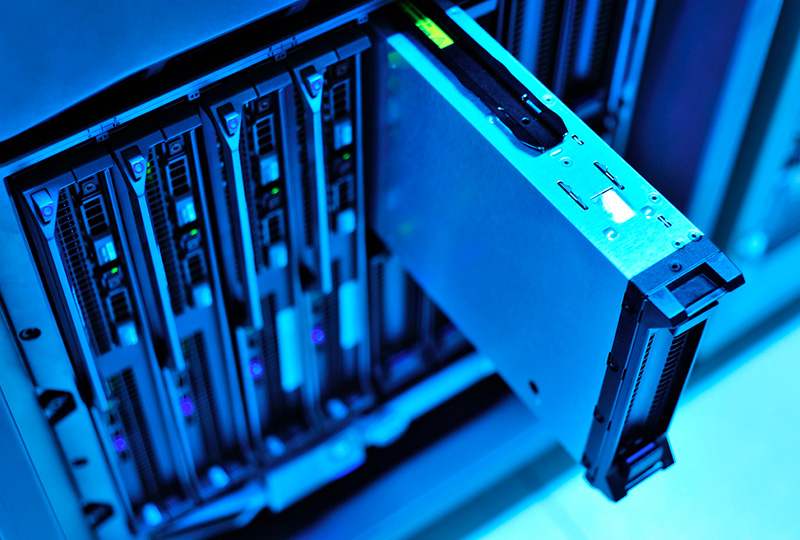
A blade server is a thin, modular server installed in a special chassis (a large case). One such module, called a blade, contains everything needed for operation: a processor, RAM, storage, and network interfaces. The chassis, in turn, provides power, cooling, and network connectivity for all blades installed within it.
More Benefits, Less Space: The Main Advantages of Blade Servers
- Space savings.
Thanks to the high density, a single chassis can accommodate from four to several dozen servers. - Unified management.
The blade chassis allows for centralized management of all servers, significantly simplifying administrative work. - Easy and fast scaling.
Need to add another server? Simply install another blade into the chassis, and you’re ready to go. - Savings on power and cooling.
Instead of using separate power supplies and fans for each server, blades share power and cooling. This reduces energy consumption and significantly simplifies future maintenance.
Ultimately, blade servers are a way to make infrastructure more compact, more cost-effective, and easier to maintain.
Who most often chooses blade servers and why?
- Data centers.
Limited space, high hardware density, and energy-saving requirements make blade servers an ideal solution for large server farms. - Cloud platforms.
IaaS and SaaS providers actively use blade servers for rapid virtual machine deployment, resource scaling, and load management. - Financial sector.
Banks, exchanges, and analytics platforms value blade servers for their high performance and stability when working with large data sets in real time. - Scientific and engineering calculations.
Modeling, simulation, and analytics require the rapid processing of vast amounts of data. Blade systems handle this through their architecture and high power density. - Large businesses and corporate IT networks.
Where IT infrastructure needs to be centralized, reliable, and easily scalable, blade servers simplify management and reduce costs.
Not Perfect: The Downsides of Blade Servers
- High cost.
The chassis itself is not cheap. Even if individual blade modules are reasonably priced, the initial investment in the system is higher than for conventional servers. - Manufacturer dependency.
Each brand has its own chassis and modules. Blades from one manufacturer are typically incompatible with equipment from another. This creates limitations when selecting or upgrading components. - Cooling requires attention.
When blades are packed tightly together, the load on the cooling system increases. Without proper ventilation and air conditioning, overheating is possible. - Risks of chassis failure.
All equipment within a chassis is interconnected. If the entire chassis fails, all servers installed within it are affected. This is critical for systems where uninterrupted operation is essential.
The Key Things to Know About Blade Servers: A Summary
Blade servers are becoming an increasingly popular solution for building modern IT infrastructure, especially where compactness, scalability, and energy efficiency are important. They help simplify management and save space and resources.
- Blade servers are modular devices installed in a common chassis that provides power, cooling, and connectivity.
- They are most in demand in data centers, cloud platforms, the financial sector, science, and the corporate environment.
- They save space thanks to high server density.
- Centralized management via the chassis simplifies administration.
- Scaling is fast: just add a new module.
- Shared power and cooling reduces energy costs and simplifies maintenance.
- The main disadvantages are: high initial cost, manufacturer dependence, increased cooling requirements, and risks of chassis failure.

