



97% of consumers research local businesses online before making a decision.
The statistic is highly significant.
What if your company doesn’t appear in the top results?
You’re missing out on a huge opportunity.
Local SEO helps you gain visibility among customers near your business .
Whether it’s through Google Maps, an optimized Google Business listing, or well-managed customer reviews?
Every detail counts when it comes to improving your ranking.
- But how exactly does it work?
- What factors influence ranking and what are the most effective strategies for standing out?
We’ll see how to optimize your local presence, attract more visitors, and most importantly…
Convert these searches into real customers.
Understanding local SEO
What is local SEO?
Local SEO is simply the art of being visible in the right place at the right time.
Specifically?
The goal is to optimize a company’s online presence to appear in search results for users located nearby.
When someone types:
- “Hairdresser near me”
- “best Italian restaurant in Lyon”…
Google will display a list of nearby establishments.
This is the famous Local Pack, those three cards that appear just below the Google Maps map.
And that’s where everything happens.
Key elements of local SEO:
- The Google Business Profile → The essential digital business card
- Customer reviews → They influence ranking and trust
- Local keywords → “Pizzeria in Bordeaux” is better than “good pizza”
- Local backlinks → Links from other local businesses
- Directories and citations → Consistency of name, address and phone number across the web
In short, it’s a mix between classic SEO optimization and a well-maintained local presence.
And today, not being visible locally means letting customers slip through your fingers.
Why is local SEO essential for businesses?
It has become a reflex: we no longer travel without checking reviews, address or opening hours on Google.
Some figures that speak for themselves:
- 76% of local searches result in a store visit within 24 hours
- 28% of local searches result in a quick purchase
- 50% of Google listings contain errors (opening hours, address, phone number, etc.)
For a physical business, not optimizing its local SEO means losing revenue.
- A restaurant that’s poorly listed on Google Maps?
- Customers who can’t find a hairdresser whose schedule is up to date with their needs?
- A shop ignored by local searches?
With good SEO, you don’t just have to be on the internet. You attract the right customers at the right time.
How does local SEO work?
Key factors in local ranking
Local SEO relies on a set of criteria that Google uses to rank businesses in search results.
To appear at the top of the Local Pack?
❌ Having a Google Business Profile is not enough…
✅ Several strategic elements also need to be optimized.
The main factors that influence local SEO:
- Relevance → Correspondence between the search and the activity
- Proximity → Distance between the user and the company
- Popularity → Number and quality of customer reviews
- Consistency of information → Name, address, phone number identical everywhere
- Local backlinks → Links from other regional sites
- Google Maps presence → Optimized photos, description, opening hours
In short, Google wants to ensure that a company meets local expectations.
The more optimized it is?
The more likely she is to appear ahead of her competitors.
Google My Business: the foundation of local SEO
It’s impossible to talk about local SEO without Google Business Profile (formerly Google My Business).
This is the tool that allows you to be listed on Google Maps and to appear in the Local Pack.
Why is it essential?
- It’s free → One of the few Google tools accessible at no cost
- It’s visible → The listings appear first on mobile and desktop
- It’s interactive → Customers can leave reviews and ask questions
Key elements to optimize on your profile:
- Name, address, telephone
- Main and secondary categories
- High-quality photos
- Customer reviews
- Regular publications
A well-maintained and up-to-date account helps a business stand out and gain visibility on Google.
Proximity signals and their impact on visibility
Google prioritizes local relevance.
Its algorithm analyzes several signals to determine if a company is truly close to the user and worthy of being highlighted.
What are these signals?
- User geolocation
- The address listed on the Google Business Profile
- Local mentions on the website
- Local quotes
- Local engagement
A business that plays well on these signals can dominate its sector and capture local searches more effectively.
Implementing an effective local SEO strategy
Optimize your Google My Business listing
A well-filled and regularly updated Google Business Profile is the basis of effective local SEO.
It is this that allows a business to appear on Google Maps and in the Local Pack of search results.
Here are the elements to optimize to gain visibility:
- Name, address, phone number (NAP) → Identical across all channels
- Primary and secondary categories → To properly target the activity
- Detailed description → Integrate local keywords
- High-quality photos and videos → 42% more clicks
- Up-to-date hours → Google favors well-maintained listings
- Regular publications → Offers, events, new products
- FAQs and answers to questions → Strengthening engagement
A well-optimized listing sends a strong signal to Google: this business is active, relevant, and worthy of being featured.
Working on customer reviews to improve your ranking
Customer reviews are one of the most influential factors in local SEO. Google takes them into account when ranking businesses.
And what about the users?
They use it to decide where to go.
Why is this essential?
- More reviews = more trust → 88% of consumers read reviews before buying
- Recent reviews → 73% of customers do not trust reviews older than 3 months
- Better conversion rate → A rating above 4 stars is reassuring and attracts more
How can I get more reviews?
- Request after a purchase → Via email, SMS or in store
- Reward repeat customers → Offer a small bonus or discount
- Respond to all reviews → Positive and negative
- Make it easier to leave a review → Direct Google link, QR code
A good volume of positive reviews boosts visibility, improves click-through rates and strengthens a company’s local credibility.
Use local content to improve your SEO
A website that talks about its city, its neighborhood, and the needs of its local customers has a better chance of ranking well on Google.
The message is clear: I am a stakeholder in the region.
And Google likes that.
Local content is a powerful tool for attracting qualified visitors and improving search engine ranking.
What types of content should you prioritize on your page?
- Articles about local events → Concerts, markets, fairs…
- Customer case studies → Testimonials from local businesses
- Practical guides → “ The 5 best restaurants in [city]”
- Specific pages per city/neighborhood → Optimized with local keywords
Why will this work for your SEO?
- Google prioritizes relevant and geolocated content.
- Internet users love local recommendations
- This strengthens the company’s authority in its area
Advanced local SEO techniques
Obtaining local backlinks to boost authority
Backlinks remain a pillar of SEO, and for local SEO, links from local sites are the most powerful.
A restaurant that receives a link from a local food blog?
A shop listed by the local chamber of commerce?
They will benefit from a significant boost in visibility on Google.
How to obtain relevant backlinks?
- Exchange with local partners
- Provide useful content
- Participate in events
- Contact the local press
Google values sites that integrate into a local ecosystem.
The more backlinks come from local sources?
The more the search engine understands the importance of the company to its geographic area.
Utilize local directories and citations
Online directories still play a role in local SEO.
Provided… that they are well chosen.
❌ Registering everywhere is pointless.
What matters?
✅ It’s about being present on the most relevant platforms for your sector.
Some essential platforms:
- Google My Business → Essential for appearing on Google Maps
- Yelp, Yellow Pages, TripAdvisor → Depending on the activity
- Chambers of commerce and local associations → Very well regarded by Google
- Regional blogs and media → Trusted resources for residents
The main issue?
Ensure total consistency of NAP (Name, Address, Telephone) information across all directories and citations.
A single spelling difference or an old number still displayed can cause confusion and reduce local visibility.
Companies that consistently and well-placed citations send positive signals to Google.
It’s a simple yet effective way to improve your local ranking and gain credibility with customers.
Optimizing your website for voice and mobile search
Today, nearly half of local searches are done on mobile.
And what about the rise of voice assistants like Siri, Alexa, or Google Assistant?
Local SEO needs to adapt to new habits.
How to make a website more effective for voice and mobile search?
- Improve loading speed
- Use a responsive design
- Optimize for conversational queries
- Structure FAQs with structured data
A voice search is often phrased as a question:
“Where can I find an open bakery near me?”.
Does the site specifically answer these types of queries?
It is more likely to be displayed first in mobile and voice search results.
If you want to take your learning further, discover the best SEO training courses .
Local SEO and social media: how to leverage them?
Social media is not a direct ranking factor in SEO, but it strongly influences local visibility.
An active business on Facebook or Instagram generates engagement, which sends positive signals to Google.
Some levers to use:
- Optimize profiles → NAP information (Name, Address, Phone) identical everywhere
- Encourage reviews → Boost local visibility
- Sharing geotagged posts → Google detects these signals for ranking
- Create engaging content → Stories, events, customer testimonials
A restaurant that posts photos of its dishes, with the location tagged, is more likely to appear in local search results.
In the same way?
A well-commented Facebook post can indirectly boost local SEO by attracting more visitors to the site.
Measuring and improving your local SEO
The best tools to track your local performance
Monitoring local SEO performance is essential to know if the actions implemented are bearing fruit.
Several tools are available to analyze customer ranking, visibility, and engagement.
Here are some essentials:
- Google Business Profile Insights → Tracking searches, clicks, and calls
- Google Search Console → Local Organic Traffic Analysis
- Google Analytics → Measuring visits from local searches
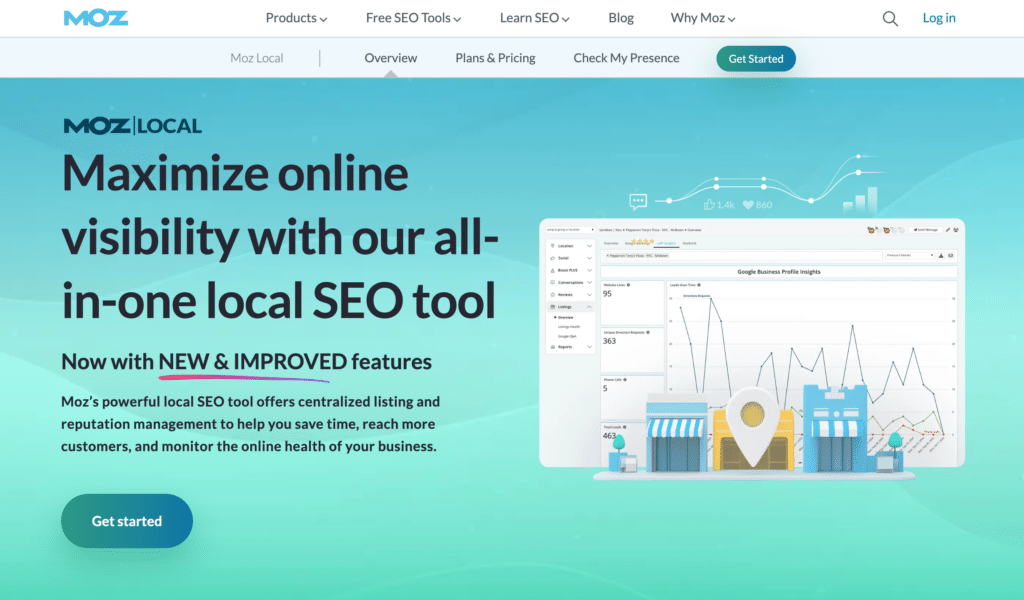
- Moz Local → Verify NAP information on the web
- BrightLocal → Tracking rankings and customer reviews
- SEMrush / Ahrefs → SEO audit and local keyword research
Using these tools helps to identify what works and what doesn’t.
What if a Google My Business establishment page isn’t attracting enough clicks, or if a local keyword isn’t performing?
Adjustments are needed.
How to analyze the results and adjust your strategy?
❌ Simply looking at the numbers is not enough…
We need to understand what they mean in order to adapt the strategy accordingly.
Some key indicators to monitor:
- Number of local impressions
- Clicks on the route and calls
- Local conversion rate
- Quality and quantity of customer reviews
If impressions are increasing but clicks remain low?
Perhaps the Google Business listing lacks appeal.
If the reviews are positive but few in number?
We need to encourage more customers to leave a review.
Monitor the competition to stay ahead of the curve
Understanding what competitors are doing helps to adjust one’s own strategy.
❌ This is not about copying.
✅ But to identify opportunities and areas for improvement.
A few simple actions to keep an eye on them:
- Analyze their Google Business listing → Number of reviews, photos, description
- Track their local positions → Compare rankings on strategic keywords
- Observe their local backlink strategy → See where they are getting links
- Monitor their social media engagement → Identify the posts that generate the most interaction
Is a competitor gaining visibility?
Perhaps they have optimized their Google listing or added better-ranked content.
Another one gets a lot of reviews?
He has undoubtedly implemented an effective strategy to encourage his clients to provide testimonials.
Key takeaways
- Google My Business is the foundation → A well-filled and up-to-date listing boosts your visibility.
- Customer reviews matter a lot → The more numerous and positive they are, the better your ranking.
- NAP information must be consistent → Your name, address and phone number must be the same everywhere.
- Local content makes the difference → Articles, specific pages, local FAQs: anything that strengthens your presence in your region.
- Local backlinks boost your authority → Being cited by local sites enhances your company’s credibility.

