



Every day, Google processes more than 7 billion searches, and every brand wants to appear at the top of the results.
An SEO expert knows how to optimize a website to improve its ranking by:
- analyzing the trends,
- adjusting the content,
- implementing strategies.
The profession is attracting more and more people.
This is normal because between freelance and agency, the opportunities are numerous, and demand continues to grow.
- But what are its missions?
- What skills do you need to master?
- And how can one train to make it a career?
We’ll go through all of this in detail, point by point.
SEO Expert: Role and Responsibilities
What is an SEO expert?
An SEO expert is, first and foremost, a web strategist.
His objective?
Improve the visibility of websites on search engines, particularly Google, which holds 91.54% of the market share.
SEO rests on three pillars:
- The technique → Code and performance optimization.
- Content → Writing and structuring web pages.
- Netlinking → Acquisition of external links to strengthen authority.
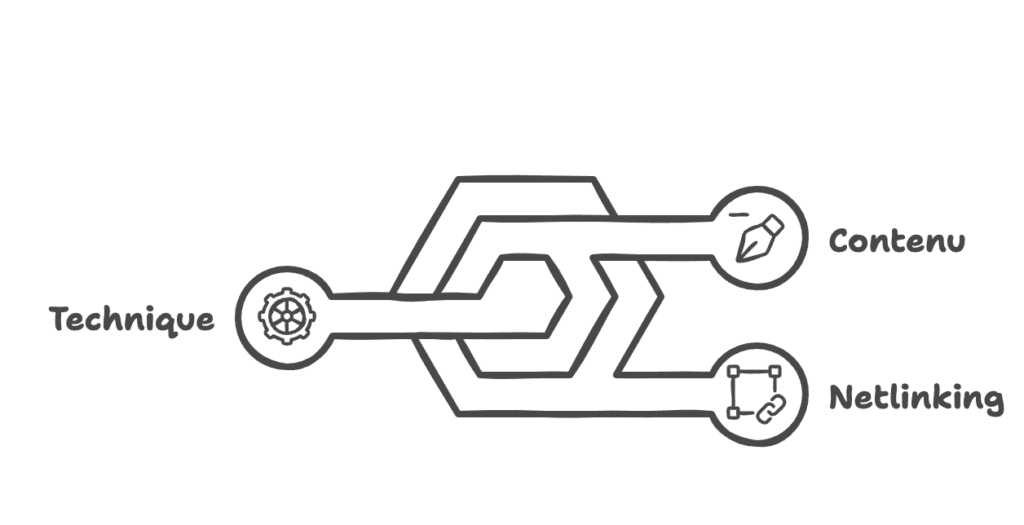
The SEO expert analyzes the results, adjusts the strategies and adapts to changes in the algorithms.
With over 200 criteria influencing page ranking, the job requires constant monitoring and a data-driven approach.
What does a search engine optimization (SEO) consultant do?
The SEO consultant intervenes at several levels to optimize a site’s presence on Google.
Its missions vary according to the needs of companies, but often follow a well-defined structure.
- Complete SEO audit → Performance analysis and identification of obstacles.
- Technical optimization → Loading speed, HTML markup, mobile-friendly.
- Content strategy → Keyword research and production of optimized articles.
- Acquiring backlinks → Improving site authority.
- Monitoring and reporting → Analysis of results and strategic adjustments.
But an SEO expert doesn’t just apply rules…
He tests, experiments and adapts his methods according to the evolution of search engines.
Google makes more than 4,000 algorithm updates per year, making adaptation essential (even mandatory) to maintain a good ranking.
The 3 pillars of SEO mastered by an expert
The technique: optimizing structure and speed
A website that is poorly optimized technically will never perform well on Google…
And so what? Regardless of the quality of its content.
The SEO expert therefore begins by analyzing the site’s structure to ensure that it is fast, fluid and understandable for Google (and other search engines).
Google uses more than 200 criteria to rank pages, and page load speed is one of the most important.
A page that takes more than 3 seconds to load?
It is already losing a large portion of its visitors…
Technical optimizations involve several steps:
- Improve speed → Reduced CSS and JavaScript files.
- Optimize indexing → Clear and well-structured site map.
- Enhance UX → Responsive website and smooth navigation.
- Secure with HTTPS → Trust factor for Google.
✅ Good SEO is based on solid foundations.
❌ If the site is poorly designed, everything else collapses.
Content: Writing and structuring for Google
Google processes more than 7 billion searches per day.
To be visible and stand out from the crowd?
✅? Relevant and well-structured content is needed.
❌A poorly optimized text, even if interesting, will not reach its audience.
The content must meet users’ search intent while also complying with search engine requirements.
Always strive for that balance!
Some rules to follow (to the letter):
- Finding the right keywords → Research and trend analysis.
- Structuring articles → Hn tags, short paragraphs, bulleted lists.
- Write for the reader and Google → Fluid but optimized text.
- Add media → Compressed images and relevant videos.
- Focus on length → Highly ranked pages contain an average of 1,447 words.
Content is the raw material of SEO.
If used incorrectly, it remains on page 10…
Links: Building Authority with Link Building
Without inbound links, a website lacks credibility.
Without credibility, there is no visibility…
Simple.
Google gives more weight to pages that receive links from reputable sites.
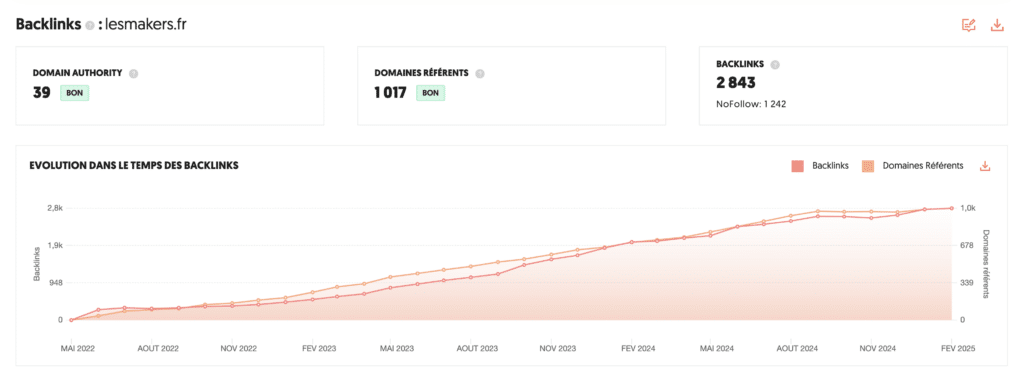
Link building is therefore an essential strategy. It relies on several methods:
- Obtaining backlinks → Guest articles, press relations.
- Create viral content → Guides, studies, infographics.
- Avoid toxic links → Check the quality of sources.
A site with good authority on Google has a greater chance of reaching the top of the results and staying there permanently.
It is even a prerequisite for many competitive queries.
What skills are needed to become an SEO expert?
Mastering essential SEO tools
Doing SEO without tools? It’s like a pilot without a dashboard.
AVERAGE…
Essential tools include:
- Google Analytics → Traffic and visitor behavior tracking.
- Google Search Console → Indexing, technical errors and performance.
- Ahrefs / Semrush → Keyword and backlink analysis.
- Screaming Frog → Technical audit of the site.
- PageSpeed Insights → Loading speed optimization.
Each tool helps to better understand the strengths and weaknesses of a site.
A good SEO expert knows how to combine them judiciously to refine and perfect their strategy.
Understanding Google’s algorithm and its updates
Google never sleeps.
Its algorithm is constantly evolving, and each update can impact the ranking of sites.
An SEO expert must remain constantly vigilant and adapt their strategies according to changes.
Some major Google updates:
- Panda → Penalizes low-quality content.
- Penguin → Penalizes artificial links.
- Hummingbird → Improves query understanding.
- Core Web Vitals → Prioritizes user experience.
Analyze and interpret traffic data
If you want to be a good SEO, don’t just publish content and optimize pages.
You must constantly analyze the results obtained in order to adjust your actions.
Key metrics to monitor:
- Organic traffic → Number of visitors from Google.
- The bounce rate → Indicates whether visitors stay on the site.
- The conversion rate → Turns visitors into customers.
- The CTR (Click-Through Rate) → Measures the attractiveness of titles and descriptions.
- The number of backlinks → Impacts the site’s authority.
Freelance or SEO agency: which path to choose?
Working as a freelancer: advantages and disadvantages
Being a freelance SEO consultant means embracing a certain form of freedom, but also uncertainty.
This way of working mainly appeals to those who want to manage their own schedule and choose their clients.
But it also requires a discipline and organization that is almost military-like…
What are the advantages of freelancing?
- Total freedom → You choose your missions and hours.
- Evolving income → The more expertise you have, the more you charge.
- Diversity of projects → Working across different sectors.
- Complete autonomy → No boss or hierarchy.
What are the potential drawbacks to anticipate?
- Irregular income → No fixed salary at the end of the month.
- Ongoing prospecting → Finding clients takes time.
- Administrative tasks → Accounting, invoicing, declarations.
- Professional isolation → No team to share challenges with.
Joining an SEO agency: opportunities and limitations
Working in an SEO agency means joining a team, following processes and specializing in certain tasks.
The environment is more stable than in freelancing, but leaves less room for flexibility.
What are the opportunities offered by an agency?
- Job security → A stable salary every month.
- Access to the best tools → Ahrefs, Semrush, Screaming Frog, etc.
- Teamwork → Exchange with other experts.
- Large-scale projects → National and international clients.
The limitations of an agency?
- Less freedom → Imposed schedules and missions.
- Capped salary → Less career progression than freelancing.
- Forced specialization → We often only manage one aspect of SEO.
- Deadline pressure → Multiple projects to manage simultaneously.
Working in an agency is also a good stepping stone before going freelance. You acquire automatic reflexes and processes that you will always keep.
How can I train to become an SEO expert?
Free and paid SEO training courses
There are several ways to learn about SEO.
Some start out as self-taught individuals using free resources.
Others prefer to invest in paid training courses to save time and avoid mistakes.
There are no “good solutions” .
Only different paths.
The free options allow you to lay a solid foundation:
- Google Digital Garage → Free training on digital marketing.
- Backlinko → Complete articles and guides.
- Moz Academy → Online resources on SEO.
- YouTube → Detailed tutorials from SEO consultants.
Paid training courses, on the other hand, offer structured learning paths:
- Semrush Academy → Advanced SEO training.
- LiveMentor → SEO training with personalized follow-up.
- Udemy & Coursera → Complete courses at affordable prices.
- Training in agencies → Programs designed by experts.
The choice depends on the level, the objectives (and the income).
You can very well start with free resources and then invest in paid training to go faster and further.
If you want to delve deeper into the subject, check out our comparison of the best SEO training courses .
Recognized SEO certifications
An SEO certification is not mandatory, but…
It can boost credibility and help secure assignments or a job in an agency.
The most recognized:
- Google Analytics Certification → Understanding web traffic analysis.
- Google Ads Certification → To master paid search engine advertising (SEA).
- HubSpot Content Marketing → Focus on SEO and content marketing.
- Yoast SEO for WordPress → Optimize SEO on WordPress.
These certifications validate specific skills, useful for proving one’s expertise to a client or employer.
If you want to delve deeper into the subject, check out our comparison of the best SEO training courses eligible for CPF funding .
Learning by doing on real projects
Let’s be honest.
Nothing replaces field experience.
Reading articles, taking courses? That’s useful.
But true learning comes from putting things into practice.
Here’s how to make effective progress:
- Create a blog → Experiment with SEO on your own site.
- Conduct tests → Modify content, monitor ranking.
- Working as a freelancer → Acquiring initial assignments on client sites.
- Analyze trends → Observe Google updates.
- Participate in SEO forums → Exchange ideas with other experts.
What salary can an SEO expert expect in 2026?
Average salary of an SEO consultant
Search engine optimization (SEO) is one of the most profitable levers in digital marketing.
49% of marketers even claim that organic offers the best ROI.
Result ?
Companies are looking for SEO experts who can optimize their visibility on Google, which holds 91.54% of the search engine market.
But how much does an SEO consultant earn in 2026?
Salaries vary depending on experience, location, and status.
In the United States, the median salary for an SEO expert reaches $69,800 per year .
In Europe…
The differences are significant: a consultant in London or Berlin often earns more than in France.
Salary trends and outlook
SEO evolves rapidly.
Very quickly.
Google is constantly adjusting its algorithm, and the demand for experts remains strong.
Those who continuously train and master the technical, strategic and analytical aspects can quickly climb in salary.
The others? They stagnate or lose their jobs… and AI won’t help them!
Factors that influence income:
- Level of expertise → A technical SEO is better paid.
- Business sector → E-commerce and SaaS pay more.
- Location → Paris and London offer better salaries.
- Certifications → Google Analytics, Semrush, Ahrefs enhance a profile.
- Freelance vs. employee → The freelancer can double their income.
- Data experience → SEO traffic analysis is a big asset.
The best SEO experts know how to combine technical optimization, content strategy, and link building.
These skills are what increase their value on the market.
Key takeaways
- SEO is a profitable lever → 49% of marketers consider it the best channel in terms of ROI.
- An SEO expert optimizes visibility → They work on technical aspects, content, and link building.
- Key skills → Mastering SEO tools, understanding Google algorithms and analyzing traffic.
- Variable salaries → Between €25,000 and €80,000/year , more for freelancers.
- Freelance vs. Agency → More freedom as a freelancer, but also more responsibilities.
- The best training courses → Google Analytics, Semrush Academy, recognized certifications.
- Experience makes the difference → The more years of experience an SEO consultant has, the more sought after they are.

