



The evolution of computer technology
The evolution of computer technology never stands still. While today we’re discussing processor performance and video memory capacity, tomorrow the focus will shift to fundamentally different architectures.
However, the future of desktop PCs is already taking shape, and key trends are not only power but also aesthetics, ease of assembly, and maintenance. In this context, two revolutionary concepts are coming to the fore: cable-free design and a modular approach to construction.
A striking embodiment of these ideas is MSI’s ambitious project, MSI Project Zero. This concept reimagines the appearance and assembly of a modern personal computer, offering an alternative to traditional cases with their tangled web of cables.
Let’s take a closer look at what lies behind this name and why this trend is considered one of the pillars of the computer of the future. Essentially, we are standing on the threshold of a new era, where the internal layout of a system unit is becoming the focus of engineers and designers, rather than a secondary technical necessity.
What is quantum computing?
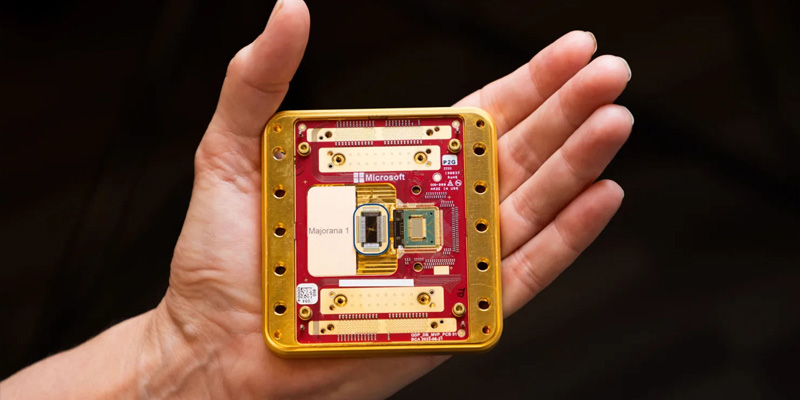
Before delving into the details of the wireless setup, it’s worth taking a quick detour into a related, yet futuristic, field. A quantum computer is a device that uses principles of quantum mechanics, such as superposition and entanglement, to process data.
Unlike a classical PC, which operates on bits (0 or 1), a quantum computer uses qubits, which can be in both states simultaneously. This opens up enormous possibilities for solving problems beyond the capabilities of today’s supercomputers: modeling molecules, optimizing complex systems, and breaking encryption.
While the widespread availability of quantum computers is still a distant prospect, their development demonstrates how radically computing paradigms can shift. A similar shift, but in the world of consumer hardware, is represented by MSI Project Zero, which is changing the paradigm of desktop system assembly.
While scientists struggle with qubit decoherence, MSI engineers are battling cable chaos, and in both cases the goal is to achieve new levels of order and efficiency.
How does a quantum computer work?
The operating principle of a quantum computer is fundamentally different from that of a conventional PC. Its system is based on qubits—the smallest units of information.
Through superposition, a qubit can perform computations with all possible states simultaneously, providing exponential growth in computing power with the addition of each new qubit.
Maintaining qubit functionality requires conditions close to absolute zero, making such devices extremely expensive and difficult to operate. Meanwhile, innovation in mainstream PCs, such as MSI Project Zero, aims for simplicity and elegance.
If a quantum computer aims to remove computational limitations, then this project aims to remove cable restrictions inside the case, making assembly and upgrades as simple and aesthetically pleasing as possible.
An interesting parallel can be drawn: the complex cooling system of a quantum computer is hidden from the user, providing only an interface for interaction. Similarly, in Project Zero, the entire technical “kitchen” with its wiring is hidden on the back of the motherboard, leaving the user with only a pristine view of the finished system.
Types of quantum computers
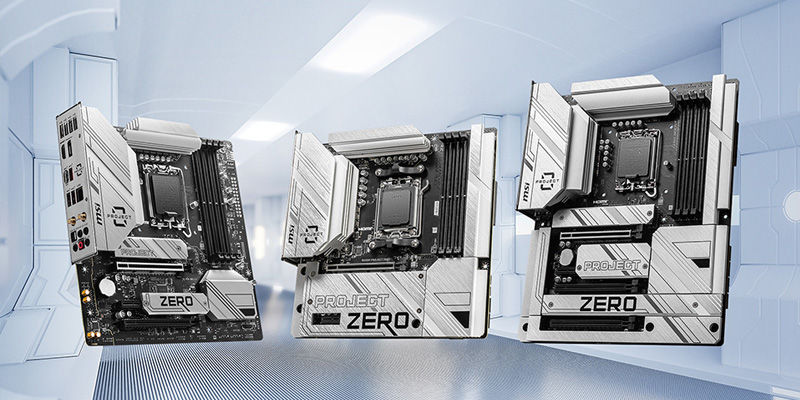
Quantum Annealing: The Key to Optimization
One approach is quantum annealing, designed to solve optimization problems. Such devices are already finding application in logistics and financial modeling.
Their architecture is specialized, but it’s precisely this specialization that allows them to effectively address specific problems. There’s also a place for specialized solutions in the PC world, and the modular approach embedded in MSI Project Zero allows for a system to be quickly adapted to specific needs, whether it’s a gaming PC or a workstation, by simply swapping or adding modules.
Superconducting quantum computers: computing at the edge of possibilities
The most common format, developed by companies like Google and IBM, uses superconducting circuits cooled to ultra-low temperatures and is the primary testing ground for quantum algorithms.
The stability and controllability of such circuits is a key challenge. In the MSI project, stability and control are achieved through thoughtful design and strict connector placement standards on the back of the board, eliminating assembly errors.
Quantum computers with trapped ions: precision and longevity
In these systems, qubits are ions confined in electromagnetic traps. Their main advantage is high stability and low error rates, as well as a relatively long coherence time.
Longevity and reliability are also important attributes of a desktop PC. MSI’s Project Zero design, which minimizes mechanical stress on cables during upgrades (they simply don’t need to be unplugged and replugged each time), potentially increases the trouble-free lifespan of components and the entire build.
Photonic quantum computers: without temperature – at maximum speed
These computers use light particles (photons) to transmit and process information. They can operate at room temperature, which is a significant technological advantage for their potential scalability and integration into existing infrastructure.
This approach echoes the idea of cleanliness and the absence of unnecessary elements: just as photonic systems strive to minimize interference, so too does MSI’s cable-free Project Zero design minimize visual and physical clutter inside the PC.
The absence of visible wires not only looks beautiful, but also improves air circulation, which directly impacts the stability and performance of the system.
How is a quantum computer different from a regular one?
A classic personal computer, whether a powerful gaming PC or an office system, processes information sequentially, according to pre-set programs.
Its architecture, based on a motherboard, central processing unit, RAM, and graphics card, has achieved incredible efficiency over the past decades. However, for certain tasks (cryptography, materials development, artificial intelligence), even the most powerful supercomputers are limited by their physical capabilities.
A quantum computer offers a fundamentally different path, but its practical implementation for home use is a distant future. The evolution of the classic PC, however, is happening here and now.
The key trend is simplifying user interaction with hardware. This is precisely the goal of the modular, cable-free MSI Project Zero concept, making a high-tech desktop accessible and easy to assemble, even for a novice.
The user of the future, like the user of today, wants technology to serve them, not them to serve technology. Project Zero answers this demand by transforming the assembly process from a technical chore into an engaging and aesthetically pleasing experience.
Prospects of quantum technologies
The future of quantum computing remains shrouded in uncertainty, but experts agree it will change the world by solving problems that seem intractable today. This will lead to breakthroughs in medicine, the creation of new materials, and data security.
At the same time, the future of the home PC is evolving. Users increasingly value not only raw performance but also user experience: ease of assembly, a clean appearance, and ease of upgrades.
MSI, as a leading computer component manufacturer, has clearly grasped this need. Project Zero is not just a concept, but a tangible prototype of the next-generation PC.
His philosophy is that a powerful computer should be beautiful inside and out, and that maintaining it shouldn’t be a quest to untangle wires.
An ecosystem of components compatible with this standard is already emerging. For example, ATX motherboards with reverse-mounted connectors, special cases with increased clearance behind the motherboard for routing cable harnesses, and graphics cards with a repositioned power connector.
It’s a systems approach that could shape the PC form factor for years to come.
Other approaches to computing
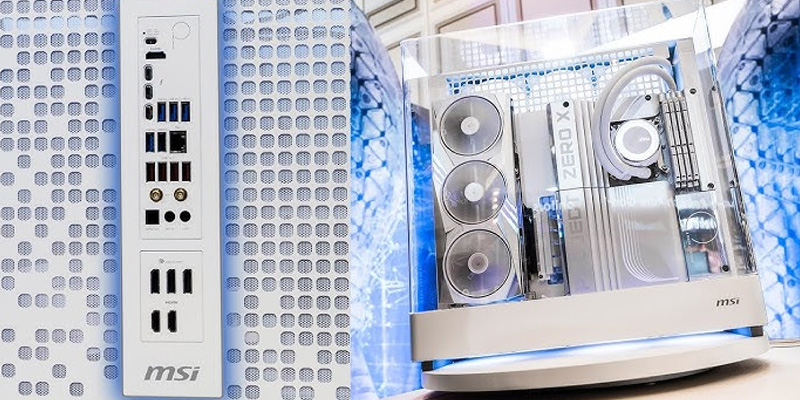
While quantum computers prepare for their moment of glory, the world of classical computing is also busy developing new architectures, some of which have common ground with the ideas of modularity and interface purity.
Neuromorphic Computing: Thinking Like the Brain
This technology involves creating chips that mimic the structure and functioning of the human brain, which has the potential to dramatically improve the efficiency of AI tasks.
Just as the brain uses neural connections, the modular PC of the future might use standardized physical and logical interfaces to quickly and efficiently replace computing modules.
Memristors: How to Combine Memory and Computation
Memristors are resistors with memory that can retain information even after power is removed. Their implementation could blur the line between RAM and read-only memory, speeding up system performance.
This focus on unification and eliminating unnecessary steps in computing echoes MSI’s Project Zero focus on unifying and simplifying the physical connection of components by eliminating unnecessary wiring.
Ternary computer and its capabilities
Unlike a binary system (0,1), a ternary system uses three states (-1, 0, 1). Theoretically, this could make computations more efficient, although this architecture has not yet achieved widespread adoption.
All of these trends, as well as the modular, cable-free approach, demonstrate that the industry is seeking an alternative to established standards, striving for greater efficiency, simplicity, and elegance.
Project Zero is just such an alternative to the traditional ATX form factor, offering a smarter and cleaner way to organize the internal space of a computer.
Computers of the Future: From Photonics to Quantum
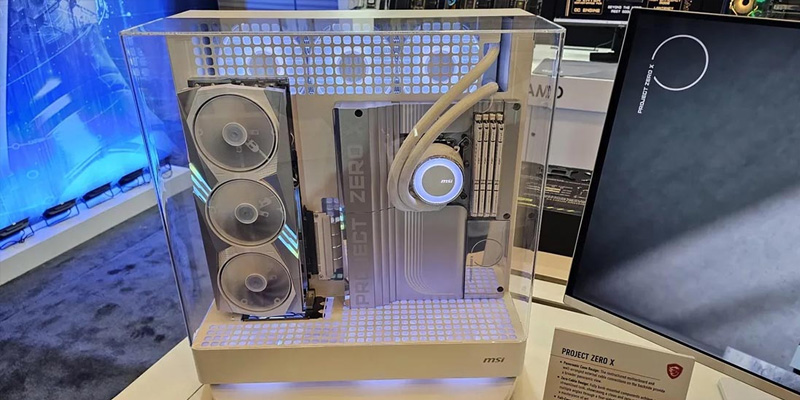
The image of the computer of the future is multifaceted. On the one hand, it includes futuristic quantum and photonic devices for solving global problems. On the other, it is an evolution of the familiar desktop, becoming smarter, quieter, more powerful, and, most importantly, more beautiful.
It’s at the intersection of power and aesthetics that innovations like MSI Project Zero are born. This project isn’t about the distant future, but about what a PC could become in the coming years.
It addresses the growing demand for custom builds and clean design, where every component is part of a larger picture, not a technical anomaly hidden behind the side of a case.
Visual appeal has become an integral part of gaming and creative culture. Transparent sides, RGB lighting, and neat cable management are all now part of computer hardware.
MSI Project Zero goes further, offering a fundamental solution rather than a cosmetic patch. It’s a future-ready PC built using the back-side connect principle, where the motherboard becomes the foundation for neatly mounting all the hardware.
Such concepts are regularly reviewed at major international exhibitions such as International CES, receiving positive reviews for their boldness and practicality.
History of quantum computers
The idea of quantum computing was first proposed in the early 1980s. Since then, numerous research groups around the world, including major IT companies, have been working to create viable models.
Every year brings news of “quantum supremacy” being achieved – the moment when a quantum computer solves a problem faster than the best classical supercomputer.
The history of cable-free and modular PCs is shorter, but no less dynamic. Initially, these were homemade mods created by enthusiasts who hid the cables themselves.
Then case manufacturers offered their solutions. And now, with the advent of MSI Project Zero, the initiative has shifted to motherboard and graphics card manufacturers—the system’s key components.
This marks a new stage in which the cable-free format is aiming to become an industry standard.
The evolution of the BTF (Back-to-Front) standard clearly demonstrates this. Initially, it was an experimental format, then BTF 2.0, and now BTF 3.0 is being discussed, which, according to rumors, may even include wireless power delivery to some components.
This is the path from an idea to its industrial implementation and standardization.
Conclusion: The Future of Computing and Its Impact on the World
The future of computing is not one, but many parallel realities. Quantum computing promises a revolution in science and industry, neuromorphic chips promise a breakthrough in artificial intelligence, and modular wireless PCs promise a revolution in user experience.
The MSI Project Zero concept clearly shows that even in the established field of desktop computers, there is room for radical improvements.
By removing cables from the front of the motherboard and creating custom modular components, MSI offers an alternative that makes building fast and enjoyable, while keeping your PC looking its best.
This is a game-changing innovation for builders and modders. The implementation of the BTF (Back-to-Front) standard and its evolution to version 3.0, which this project supports, signals the emergence of an entire ecosystem of compatible components.
This isn’t just a new motherboard—it’s a new approach to case design, power supplies, cooling systems, and graphics cards. The upgrade process transforms from tedious disassembly and wiring into a simple module replacement.
The connectors located on the rear side are securely fixed and protected from accidental damage.
Ultimately, whether it’s a quantum computer for research or a sleek, wireless PC for the home, the future belongs to technologies that make the complex simple and the powerful beautiful and accessible.
MSI Project Zero is a confident step in this direction, offering a real-world glimpse into what our personal computers will be like in the very near future.
It’s a system where design and functionality go hand in hand, and the process of building your PC becomes as creative and satisfying as the process of using it.
And while it’s still a concept and a project for enthusiasts today, it could become the new norm for all desktop computers tomorrow, setting the standard for the next decade.

