



f you own or are thinking of starting a YouTube channel , you’re probably wondering how to increase its visibility. There’s a science to becoming more visible on the platform, and it’s called SEO (Search Engine Optimization ).
By implementing certain techniques, your videos will be more visible on the platform. But YouTube SEO can seem complex if you’re a beginner. That’s why we’re going to present you with a simple guide to help your videos generate more views on YouTube .
Use YouTube keywords
On YouTube, there’s a tragic reality for creators. In fact, no matter how good a video is, if it’s not likely to interest YouTube’s audience, the platform won’t promote it. To avoid this situation, you need to carefully select your content topics in advance.
Just like Google, YouTube is a search engine . Users search for videos by typing keywords into the search bar.
Let’s say you’re eager to make an apple pie and you want to find a video that explains in detail how to make this dessert . On YouTube, you would simply type ” apple pie recipe ” in the search bar.
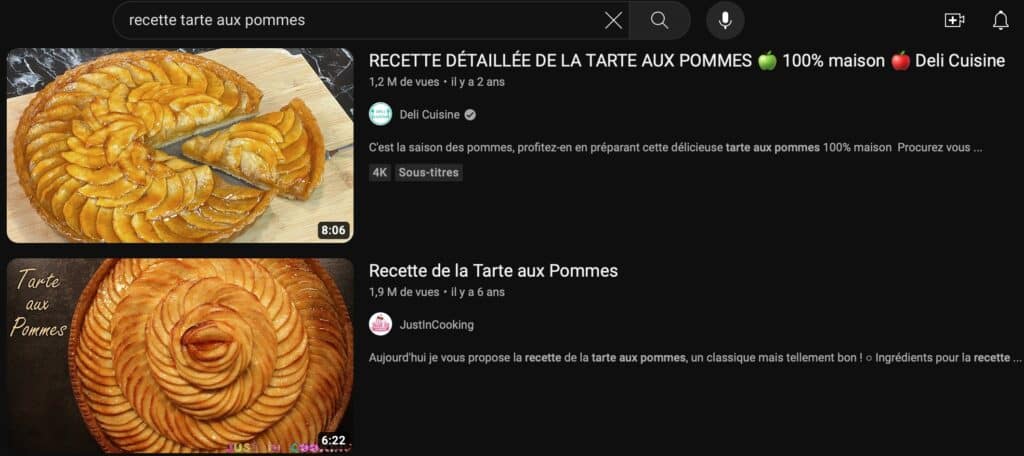
Typing this query yields dozens of different videos showing how to make an apple pie. The videos that appear first receive views every month solely due to their ranking.
The goal isn’t to make as many videos as possible to rank for a bunch of different keywords. What you need to do is select popular keywords with little competition . This way, your videos will appear in the top search results and bring you more views.
Let’s look together at how to find the best keywords to produce videos that will become popular.
How to find keywords?
To maximize the success of your videos, you need to optimize your content for the right keywords. There are several methods that will allow you to find popular keywords on YouTube . Let us introduce you to the main strategies to implement. ⤵️
First and foremost, you need a main keyword . This query should be general . The goal is to find a multitude of queries based on this keyword.
Let’s take a concrete example. Imagine you have a YouTube channel about bodybuilding . A general keyword could be ” how to gain muscle? “.
To easily find keyword ideas , you can simply use the YouTube search bar .
By entering your main search query , YouTube will display all the secondary keywords . All the queries that appear in the search bar were typed by users within the last 30 days. These are therefore topics that internet users are searching for content to watch.
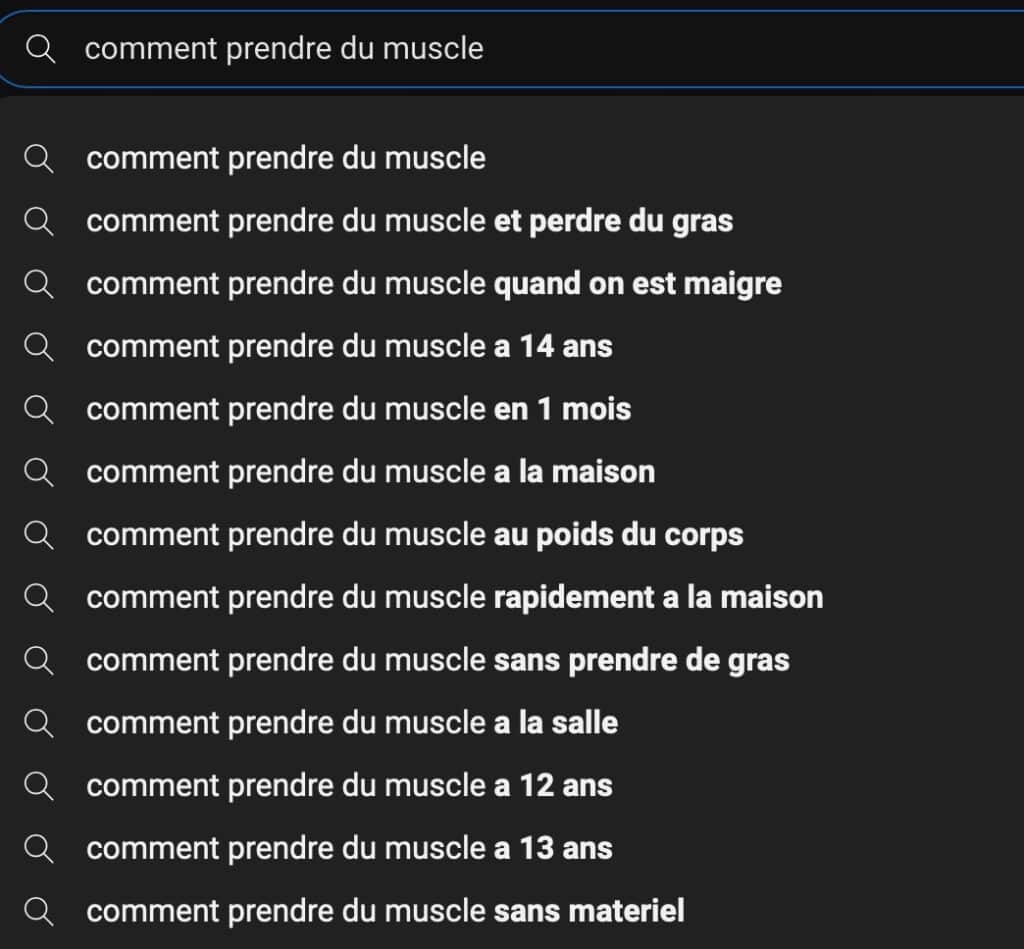
All the suggestions offered by YouTube are excellent keywords to work with . They are also the most reliable data you can obtain for keyword research, as these suggestions come directly from YouTube and not from third-party software.
The advantage is that for these queries, you wo n’t need to check their search volume . If YouTube displays them, it’s because they are searched keywords.
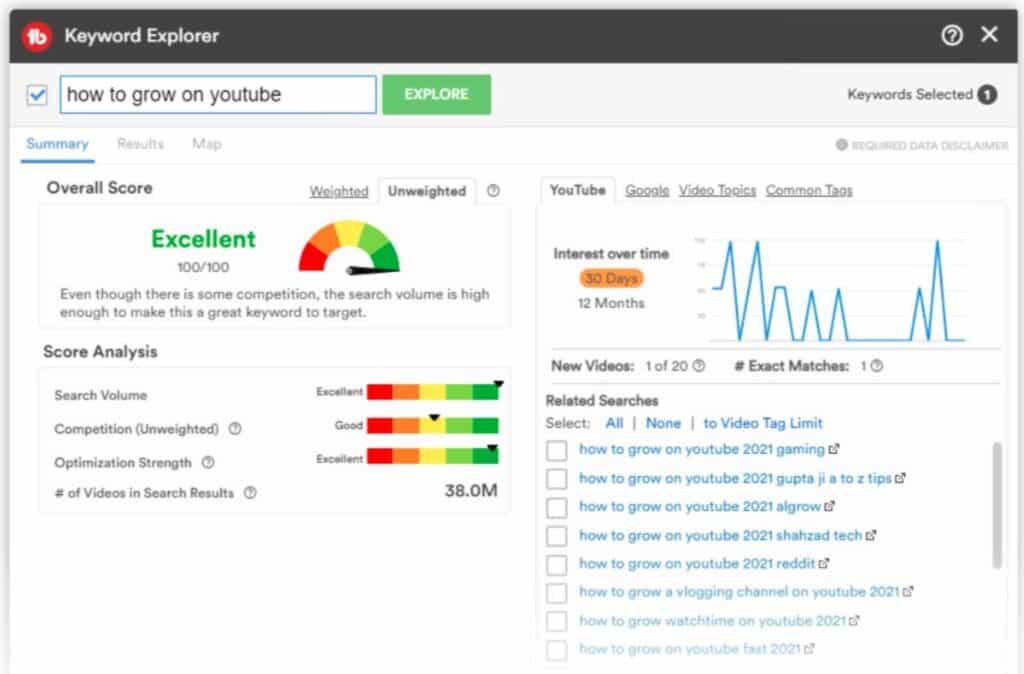
To find keywords, you can also use software . Many tools have emerged to help you gain visibility on YouTube through SEO. This is particularly true of TubeBuddy, one of the best-known software programs for increasing your YouTube visibility.
Depending on your topic and current trends, the software will suggest keywords. For each query, TubeBuddy assigns a score. This score takes into account search volume and competition. The higher the score, the more worthwhile it is to create content around that keyword.
If you want to learn more about this software, we invite you to read our review of TubeBuddy .
Some tools, particularly SEO software, will also indicate the search volume of a query. This way, you can see the popularity of a query in advance . The higher its search volume, the more views that keyword is likely to bring you.
Example with the query “ how to gain muscle? ”.
But to find keywords, you can also use free tools like Google Trends . This search engine lets you see trends, meaning the most frequently typed queries on the platform. Based on a keyword, you can find all the related topics that are popular.
We really encourage you to refine your keyword research to choose the best search queries for creating your videos. Simply because internet users who land on your videos by typing a keyword are much more qualified traffic than average.
With the right keywords, you can even earn a good amount on YouTube .
If we take the example of the search query ” how to build muscle ,” all users who type this query are interested in bodybuilding. Consequently, they are much more likely to watch a video in its entirety . This is in contrast to a user who lands on the video somewhat randomly because they saw it in their news feed. And that’s the power of SEO!
If you want to delve deeper into the subject, check out the best YouTube courses .
The criteria for a good keyword
We briefly discussed keyword search volume. In the world of SEO, this is an extremely important element, as it determines a video’s potential success. Search volume refers to the number of times a keyword is searched per month .
If a query shows a search volume of 800 , it means that the keyword is searched 800 times per month on YouTube. Of course, this doesn’t include all secondary keywords related to that query.
We recommend choosing keywords that generate at least 100 to 1000 searches per month . Below this amount, your video won’t generate many views, even if it appears at the top of search results.
The other main criterion is the competitiveness of a search query . In reality, there’s no point in targeting a keyword that generates 100,000 searches per month. There will be far too much competition, and your video will never reach the top of the search results.
To get an idea of the competition for a keyword, there aren’t a million things you need to do. You can simply type that query into the search bar and observe the number of videos found , the size of competing YouTube channels, etc.
If dozens of videos from popular YouTube channels appear, you’ll struggle to stand out. However, if after 2-3 videos, YouTube starts displaying results in English or with less relevant content, you can easily overtake your competitors.
To be more precise, you can use a command via Google.
=> Keyword name site:youtube.*
By typing this command, Google will return all videos that use this keyword or part of the query.
For example, if you perform this search with the keyword ” gain muscle ,” you get 167,000 results. This doesn’t mean that more than 100,000 videos have been made on the subject. But this indicator gives an idea of the difficulty of a keyword .
If we use a longer keyword such as “ gaining muscle when you’re skinny ”, we immediately see that there’s less competition . You’ll therefore have a much better chance of standing out by optimizing your video for this keyword.
Some tools display a “ Keyword Difficulty ” score and estimate the complexity of ranking for a search query based on several factors. It’s not necessarily the most reliable indicator, but it can give you an idea of a keyword’s complexity.
Video ranking indicators
Every time you upload a video, YouTube’s algorithm analyzes it to determine its ranking. Depending on the score the algorithm assigns to a video, it will be ranked higher or lower. Naturally, if it ranks well, the video will have more visibility, particularly by appearing in recommendations.
There are many criteria that determine whether a video is optimized for search engines or not. We’ll show you the main indicators that YouTube takes into account to rank videos on the platform.
Retention rate
Retention is the length of time a user watches your content . The retention rate, or average view rate, is the average percentage of a video watched. For example, a retention rate of 75% means that, on average, users watch three-quarters of the content. This metric is also called watch time, or the average viewing duration.
The more users watch a video in its entirety , the more attention the algorithm will pay to that content . The platform will want to highlight this video and will suggest it to other users, either through recommendations or in search results. This is clearly what can make a difference in SEO!
Conversely, a low retention rate will make your videos appear less interesting. YouTube will be less likely to recommend your content, as the platform believes it may not be of interest to users.
Keywords
As we saw in the first part, Google pays attention to the keywords in your videos . In our opinion, this is the most important element in SEO. A poor choice of keywords will inevitably penalize your videos’ ranking.
Depending on the keywords you use in your title, description, and other elements, Google will rank your videos. If you use the right keywords, YouTube will be more likely to recommend your videos and make them appear higher in search results.
The commitment
YouTube is first and foremost a social network. And like all social networks, engagement will have a significant impact on video ranking. Engagement is simply the likes and comments your content receives.
This is referred to as engagement rate, which is the percentage of subscribers of a YouTube channel who interact with a video.
The platform prioritizes YouTube channels with high engagement rates . If your videos receive many likes and comments, the platform will be more likely to feature them prominently.
Chain Authority
Finally, the authority of a YouTube channel is also a factor to consider in video ranking. The more popular a YouTube channel is, the easier it will be for it to have its videos indexed.
Authority is built up gradually over time as the YouTube channel gains popularity. Once your channel starts getting views and has a large number of videos, you’ll find that your new content is indexed more easily and quickly.
Click-through rate
After publication, your video will appear in recommendations or in search results for keywords . YouTube can then calculate its click-through rate ( CTR ). This percentage represents the proportion of users who see your video and click on it to watch it.
The platform pays close attention to the click-through rate (CTR) of your posts. As you might expect, the higher your CTR, the more likely YouTube is to recommend your content. Conversely, a low CTR could lower your ranking.
To achieve a high click-through rate, you will need to opt for a catchy video thumbnail and title .
Video length
Just as Google favors longer content, YouTube prefers longer videos . If your video is too short, the platform may not fully understand its topic. YouTube will therefore have difficulty ranking you.
Be careful not to create long videos that don’t add value . There’s no single optimal length for a video to rank well in search results. The goal is to create a video that provides value and appeals to users. The ideal length will also vary depending on the type of video.
When a user searches for a tutorial on a specific skill, the featured videos will be very long, as they are much more detailed. If a user is looking for a simple recipe, the opposite is true. The best content will be no longer than 10 minutes.
Optimizing a video
For each video you publish, you’ll need to implement certain things to optimize it for search engines. Here’s how to best optimize your videos:
Keywords
YouTube automatically subtitles your videos. Therefore, you absolutely must mention keywords verbally in the content you publish. This way, the keywords will appear in the subtitles. Even if they aren’t displayed to the viewer, this helps YouTube better understand the topic of your video.
Title
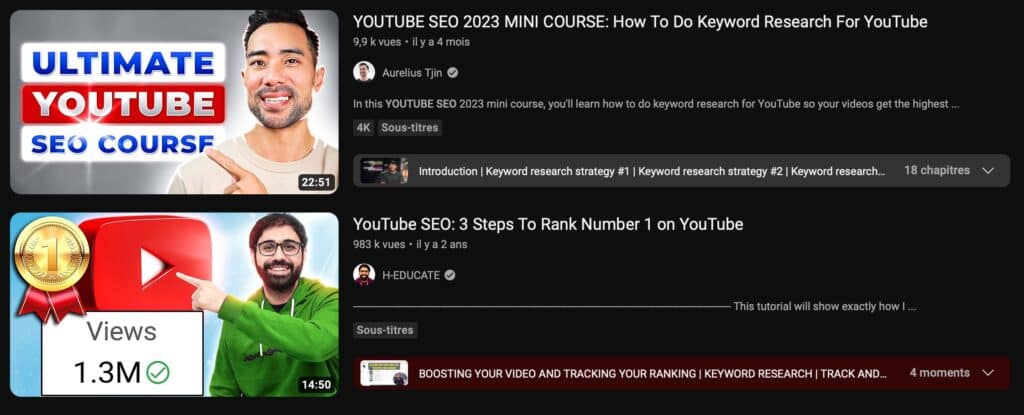
A video title should contain at least 5 words. It’s therefore easy to choose a catchy title while still including your main keyword.
Opinions differ on keyword placement. Many agree that, as with a Google SEO strategy, it’s best to place the keyword at the beginning of the title.
Description
Only a small percentage of your viewers will read your description. However, you absolutely must not neglect it. The description will allow you to explain in detail what your video is about and therefore include the main keywords you want to rank for.
Here are a few essential points for an optimized description ✒️:
- Include your main keyword in the first 25 words
- Write a description of at least 250 words
- Include the main keyword between 2 and 4 times
In your description, you might be tempted to include your keyword many times to gain visibility. But this isn’t a good idea. If you place your keyword too often in the description, Google will consider your content spam. Since keyword stuffing is penalized by a decrease in visibility, we strongly encourage you to moderate the number of times you use a main term in your description.
Summary
On your videos, you’ll have the option to add a summary. For viewers, the summary lists the main points of a video. As you probably suspect, this will also impact your search engine ranking. The summary helps Google better understand the topic of your video.
When your videos appear in recommendations or search results, YouTube displays a portion of your summary. Users can then click directly on a section of the summary to jump to the part of the video they’re interested in.
Optimizing a YouTube profile
All the videos you publish should be optimized for search engines . But SEO also involves optimizing your profile. Optimizing the title and description of your YouTube channel will help the algorithm better understand the themes of the content you offer.
We therefore invite you to write a description for your YouTube channel, including your main keywords . Again, there’s no need to write a lengthy text or stuff it with keywords. A short description incorporating your main keyword once or twice is perfectly sufficient.
Profile optimization isn’t the most important factor in ranking your videos on YouTube. However, if your videos are optimized for a specific topic but your profile isn’t, it could confuse the platform’s algorithm.

